 Add to Chrome
 Add to Firefox
 Add to Edge
Draw2Think: Harnessing Geometry Reasoning through Constraint Engine Interaction
May 20, 2026
Vision-language models solve geometry problems with rising accuracy, yet their intermediate states remain latent and unverifiable: a relation expressed in textual reasoning or drawing code carries no guarantee that a constraint-satisfying configuration realizes it. We observe that existing externalization methods based on rendered pixels or one-shot scripts fail to provide exact, per-action geometric guarantees. Enforcing geometric relations by algebraic definition closes this gap: the workspace becomes a constraint-checked evolving canvas. We present Draw2Think, a framework that recasts geometric reasoning from latent spatial inference into agentic interaction with the GeoGebra constraint engine. In a Propose-Draw-Verify loop, Draw2Think externalizes hypotheses onto an executable canvas, measures exact geometric quantities, and feeds structured observations back to the model, so subsequent reasoning proceeds from checked canvas state grounded by the shared workspace. This externalization makes two properties separately auditable: model-level Construction Fidelity (whether the canvas realizes the intended configuration) and engine-level Measurement Faithfulness (exact values and relations from canvas constraints). Across construction, outcome, and rendering evaluations, Draw2Think builds canvases that pass 95.9% predicate-level and 84.0% strict problem-level construction checks on GeoGoal, improves outcome accuracy by up to 4.1%/16.4% on planar/solid benchmarks, and attains 68.2%/90.5% strict/relaxed rendering scores on GenExam-math. Project page is available at https://draw2think.github.io/

Render-in-the-Loop: Vector Graphics Generation via Visual Self-Feedback
Apr 22, 2026Multimodal Large Language Models (MLLMs) have shown promising capabilities in generating Scalable Vector Graphics (SVG) via direct code synthesis. However, existing paradigms typically adopt an open-loop "blind drawing" approach, where models generate symbolic code sequences without perceiving intermediate visual outcomes. This methodology severely underutilizes the powerful visual priors embedded in MLLMs vision encoders, treating SVG generation as a disjointed textual sequence modeling task rather than an integrated visuo-spatial one. Consequently, models struggle to reason about partial canvas states and implicit occlusion relationships, which are visually explicit but textually ambiguous. To bridge this gap, we propose Render-in-the-Loop, a novel generation paradigm that reformulates SVG synthesis as a step-wise, visual-context-aware process. By rendering intermediate code states into a cumulative canvas, the model explicitly observes the evolving visual context at each step, leveraging on-the-fly feedback to guide subsequent generation. However, we demonstrate that applying this visual loop naively to off-the-shelf models is suboptimal due to their inability to leverage incremental visual-code mappings. To address this, we first utilize fine-grained path decomposition to construct dense multi-step visual trajectories, and then introduce a Visual Self-Feedback (VSF) training strategy to condition the next primitive generation on intermediate visual states. Furthermore, a Render-and-Verify (RaV) inference mechanism is proposed to effectively filter degenerate and redundant primitives. Our framework, instantiated on a multimodal foundation model, outperforms strong open-weight baselines on the standard MMSVGBench. This result highlights the remarkable data efficiency and generalization capability of our Render-in-the-Loop paradigm for both Text-to-SVG and Image-to-SVG tasks.
ArtiCAD: Articulated CAD Assembly Design via Multi-Agent Code Generation
Apr 14, 2026Parametric Computer-Aided Design (CAD) of articulated assemblies is essential for product development, yet generating these multi-part, movable models from high-level descriptions remains unexplored. To address this, we propose ArtiCAD, the first training-free multi-agent system capable of generating editable, articulated CAD assemblies directly from text or images. Our system divides this complex task among four specialized agents: Design, Generation, Assembly, and Review. One of our key insights is to predict assembly relationships during the initial design stage rather than the assembly stage. By utilizing a Connector that explicitly defines attachment points and joint parameters, ArtiCAD determines these relationships before geometry generation, effectively bypassing the limited spatial reasoning capabilities of current LLMs and VLMs. To further ensure high-quality outputs, we introduce validation steps in the generation and assembly stages, accompanied by a cross-stage rollback mechanism that accurately isolates and corrects design- and code-level errors. Additionally, a self-evolving experience store accumulates design knowledge to continuously improve performance on future tasks. Extensive evaluations on three datasets (ArtiCAD-Bench, CADPrompt, and ACD) validate the effectiveness of our approach. We further demonstrate the applicability of ArtiCAD in requirement-driven conceptual design, physical prototyping, and the generation of embodied AI training assets through URDF export.
Orthogonal Subspace Projection for Continual Machine Unlearning via SVD-Based LoRA
Apr 14, 2026Continual machine unlearning aims to remove the influence of data that should no longer be retained, while preserving the usefulness of the model on everything else. This setting becomes especially difficult when deletion requests arrive sequentially, because the model must repeatedly adapt without erasing previously retained knowledge. Low-Rank Adaptation (LoRA) offers an efficient way to implement such updates, but naively combining many sequential LoRA modules leads to parameter collision, causing \textit{strong interference} between tasks. We propose a static alternative based on Singular Value Decomposition (SVD)-guided orthogonal subspace projection. Our method constrains each new LoRA update during training so that it lies in the orthogonal complement of the subspaces used by earlier unlearning tasks. This preserves task isolation without requiring dynamic routing at deployment. Experiments on CIFAR-100 with ResNet-20 and on MNIST show stable behavior across long sequences of unlearning tasks. After thirty sequential unlearning tasks, state-of-the-art static fusion reduces retained accuracy from 60.39\% to 12.70\%, whereas the proposed in-training constrained optimization maintains baseline performance ($\sim$58.1\%) while preserving strong unlearning efficacy.
AmodalSVG: Amodal Image Vectorization via Semantic Layer Peeling
Apr 13, 2026We introduce AmodalSVG, a new framework for amodal image vectorization that produces semantically organized and geometrically complete SVG representations from natural images. Existing vectorization methods operate under a modal paradigm: tracing only visible pixels and disregarding occlusion. Consequently, the resulting SVGs are semantically entangled and geometrically incomplete, limiting SVG's structural editability. In contrast, AmodalSVG reconstructs full object geometries, including occluded regions, into independent, editable vector layers. To achieve this, AmodalSVG reformulates image vectorization as a two-stage framework, performing semantic decoupling and completion in the raster domain to produce amodally complete semantic layers, which are then independently vectorized. In the first stage, we introduce Semantic Layer Peeling (SLP), a VLM-guided strategy that progressively decomposes an image into semantically coherent layers. By hybrid inpainting, SLP recovers complete object appearances under occlusions, enabling explicit semantic decoupling. To vectorize these layers efficiently, we propose Adaptive Layered Vectorization (ALV), which dynamically modulates the primitive budget via an error-budget-driven adjustment mechanism. Extensive experiments demonstrate that AmodalSVG significantly outperforms prior methods in visual fidelity. Moreover, the resulting amodal layers enable object-level editing directly in the vector domain, capabilities not supported by existing vectorization approaches. Code will be released upon acceptance.
FedDis: A Causal Disentanglement Framework for Federated Traffic Prediction
Jan 30, 2026Federated learning offers a promising paradigm for privacy-preserving traffic prediction, yet its performance is often challenged by the non-identically and independently distributed (non-IID) nature of decentralized traffic data. Existing federated methods frequently struggle with this data heterogeneity, typically entangling globally shared patterns with client-specific local dynamics within a single representation. In this work, we postulate that this heterogeneity stems from the entanglement of two distinct generative sources: client-specific localized dynamics and cross-client global spatial-temporal patterns. Motivated by this perspective, we introduce FedDis, a novel framework that, to the best of our knowledge, is the first to leverage causal disentanglement for federated spatial-temporal prediction. Architecturally, FedDis comprises a dual-branch design wherein a Personalized Bank learns to capture client-specific factors, while a Global Pattern Bank distills common knowledge. This separation enables robust cross-client knowledge transfer while preserving high adaptability to unique local environments. Crucially, a mutual information minimization objective is employed to enforce informational orthogonality between the two branches, thereby ensuring effective disentanglement. Comprehensive experiments conducted on four real-world benchmark datasets demonstrate that FedDis consistently achieves state-of-the-art performance, promising efficiency, and superior expandability.
Breaking the Passive Learning Trap: An Active Perception Strategy for Human Motion Prediction
Nov 18, 2025Forecasting 3D human motion is an important embodiment of fine-grained understanding and cognition of human behavior by artificial agents. Current approaches excessively rely on implicit network modeling of spatiotemporal relationships and motion characteristics, falling into the passive learning trap that results in redundant and monotonous 3D coordinate information acquisition while lacking actively guided explicit learning mechanisms. To overcome these issues, we propose an Active Perceptual Strategy (APS) for human motion prediction, leveraging quotient space representations to explicitly encode motion properties while introducing auxiliary learning objectives to strengthen spatio-temporal modeling. Specifically, we first design a data perception module that projects poses into the quotient space, decoupling motion geometry from coordinate redundancy. By jointly encoding tangent vectors and Grassmann projections, this module simultaneously achieves geometric dimension reduction, semantic decoupling, and dynamic constraint enforcement for effective motion pose characterization. Furthermore, we introduce a network perception module that actively learns spatio-temporal dependencies through restorative learning. This module deliberately masks specific joints or injects noise to construct auxiliary supervision signals. A dedicated auxiliary learning network is designed to actively adapt and learn from perturbed information. Notably, APS is model agnostic and can be integrated with different prediction models to enhance active perceptual. The experimental results demonstrate that our method achieves the new state-of-the-art, outperforming existing methods by large margins: 16.3% on H3.6M, 13.9% on CMU Mocap, and 10.1% on 3DPW.
Empowering LLMs to Understand and Generate Complex Vector Graphics
Dec 15, 2024The unprecedented advancements in Large Language Models (LLMs) have profoundly impacted natural language processing but have yet to fully embrace the realm of scalable vector graphics (SVG) generation. While LLMs encode partial knowledge of SVG data from web pages during training, recent findings suggest that semantically ambiguous and tokenized representations within LLMs may result in hallucinations in vector primitive predictions. Additionally, LLM training typically lacks modeling and understanding of the rendering sequence of vector paths, which can lead to occlusion between output vector primitives. In this paper, we present LLM4SVG, an initial yet substantial step toward bridging this gap by enabling LLMs to better understand and generate vector graphics. LLM4SVG facilitates a deeper understanding of SVG components through learnable semantic tokens, which precisely encode these tokens and their corresponding properties to generate semantically aligned SVG outputs. Using a series of learnable semantic tokens, a structured dataset for instruction following is developed to support comprehension and generation across two primary tasks. Our method introduces a modular architecture to existing large language models, integrating semantic tags, vector instruction encoders, fine-tuned commands, and powerful LLMs to tightly combine geometric, appearance, and language information. To overcome the scarcity of SVG-text instruction data, we developed an automated data generation pipeline that collected a massive dataset of more than 250k SVG data and 580k SVG-text instructions, which facilitated the adoption of the two-stage training strategy popular in LLM development. By exploring various training strategies, we developed LLM4SVG, which significantly moves beyond optimized rendering-based approaches and language-model-based baselines to achieve remarkable results in human evaluation tasks.
SVGFusion: Scalable Text-to-SVG Generation via Vector Space Diffusion
Dec 11, 2024The generation of Scalable Vector Graphics (SVG) assets from textual data remains a significant challenge, largely due to the scarcity of high-quality vector datasets and the limitations in scalable vector representations required for modeling intricate graphic distributions. This work introduces SVGFusion, a Text-to-SVG model capable of scaling to real-world SVG data without reliance on a text-based discrete language model or prolonged SDS optimization. The essence of SVGFusion is to learn a continuous latent space for vector graphics with a popular Text-to-Image framework. Specifically, SVGFusion consists of two modules: a Vector-Pixel Fusion Variational Autoencoder (VP-VAE) and a Vector Space Diffusion Transformer (VS-DiT). VP-VAE takes both the SVGs and corresponding rasterizations as inputs and learns a continuous latent space, whereas VS-DiT learns to generate a latent code within this space based on the text prompt. Based on VP-VAE, a novel rendering sequence modeling strategy is proposed to enable the latent space to embed the knowledge of construction logics in SVGs. This empowers the model to achieve human-like design capabilities in vector graphics, while systematically preventing occlusion in complex graphic compositions. Moreover, our SVGFusion's ability can be continuously improved by leveraging the scalability of the VS-DiT by adding more VS-DiT blocks. A large-scale SVG dataset is collected to evaluate the effectiveness of our proposed method. Extensive experimentation has confirmed the superiority of our SVGFusion over existing SVG generation methods, achieving enhanced quality and generalizability, thereby establishing a novel framework for SVG content creation. Code, model, and data will be released at: \href{https://ximinng.github.io/SVGFusionProject/}{https://ximinng.github.io/SVGFusionProject/}
Forming Auxiliary High-confident Instance-level Loss to Promote Learning from Label Proportions
Nov 15, 2024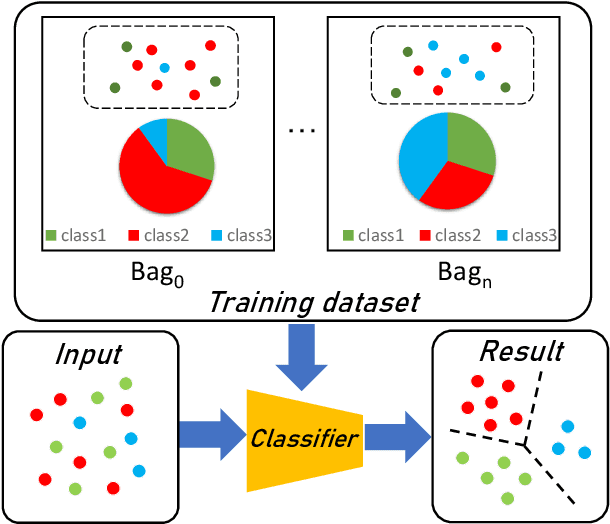
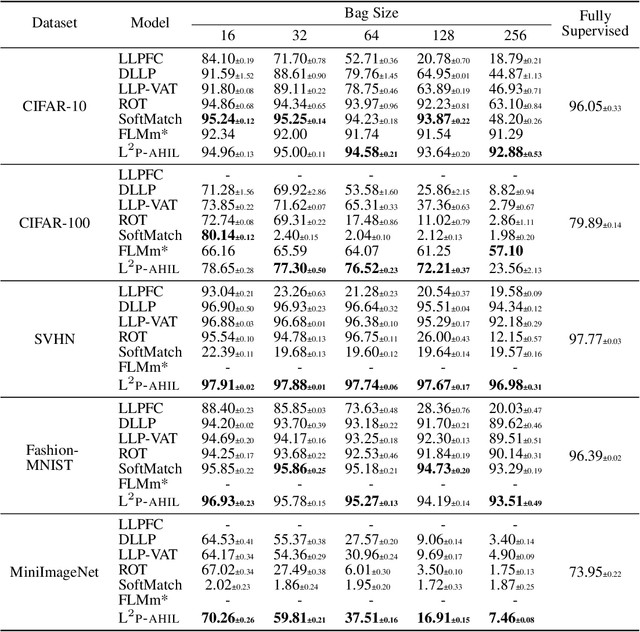

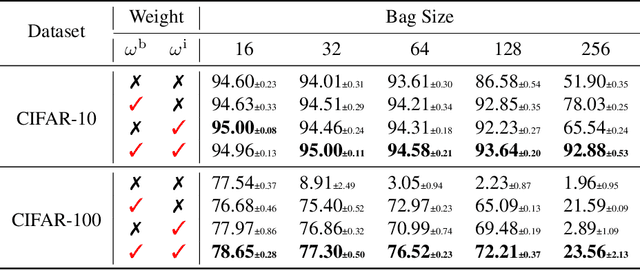
Learning from label proportions (LLP), i.e., a challenging weakly-supervised learning task, aims to train a classifier by using bags of instances and the proportions of classes within bags, rather than annotated labels for each instance. Beyond the traditional bag-level loss, the mainstream methodology of LLP is to incorporate an auxiliary instance-level loss with pseudo-labels formed by predictions. Unfortunately, we empirically observed that the pseudo-labels are are often inaccurate due to over-smoothing, especially for the scenarios with large bag sizes, hurting the classifier induction. To alleviate this problem, we suggest a novel LLP method, namely Learning from Label Proportions with Auxiliary High-confident Instance-level Loss (L^2P-AHIL). Specifically, we propose a dual entropy-based weight (DEW) method to adaptively measure the confidences of pseudo-labels. It simultaneously emphasizes accurate predictions at the bag level and avoids overly smoothed predictions. We then form high-confident instance-level loss with DEW, and jointly optimize it with the bag-level loss in a self-training manner. The experimental results on benchmark datasets show that L^2P-AHIL can surpass the existing baseline methods, and the performance gain can be more significant as the bag size increases.